


Starting a business comes with important decisions, and choosing the right business structure is one of them.
Should you operate as a sole proprietor? Form an LLC? Elect S corporation tax status? Or establish a C corporation?
Each option has advantages and limitations. Your decision can affect how much you pay in taxes, whether your personal assets are protected from business liabilities, how you compensate yourself, and how easily your company can grow.
In this guide, we’ll break down five common types of business entities in the United States, explain how they work, and help you understand which factors matter when choosing the right structure for your business.
What Are the Different Types of Business Entities?
The most common business structures and tax classifications in the United States include:
- Sole Proprietorship: A business owned and operated by one individual, without a separate legal entity.
- Limited Liability Company (LLC): A state-created entity that generally protects owners from personal liability and offers flexible tax treatment.
- Partnership: A business owned by two or more people, with different possible arrangements for liability and management.
- S Corporation (S Corp): A federal tax election available to eligible corporations and LLCs that generally allows business income to pass through to shareholders.
- C Corporation (C Corp): A corporation generally taxed separately from its shareholders, often used by businesses seeking significant outside investment.
Important distinction: An LLC is a legal structure, while an S corporation is a federal tax classification. A business can be legally organized as an LLC and elect to be taxed as an S corporation.
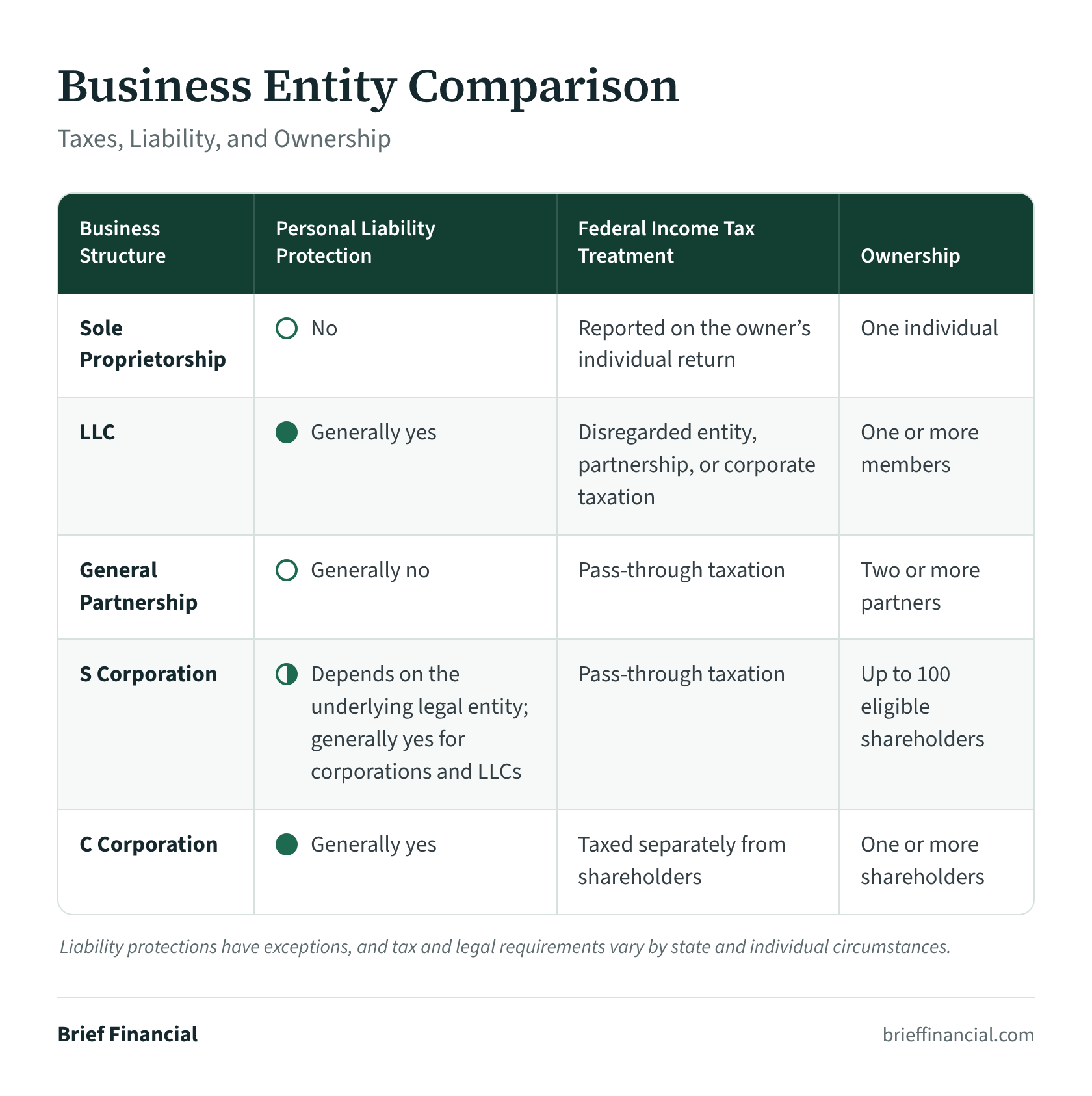
Business Entity Comparison: Taxes, Liability, and Ownership
Here’s a quick overview of the most common options:
1. Sole Proprietorship: The Simplest Business Structure
A sole proprietorship is the simplest way to operate a business in the United States.
If you start providing services or selling products independently without forming a separate business entity, you may already be operating as a sole proprietor. For example, someone offering landscaping services, freelance design, or consulting under their own name may initially operate this way.
How Is a Sole Proprietorship Taxed?
A sole proprietor generally reports business income and expenses on Schedule C, filed with their individual federal income tax return (Form 1040). Net earnings are generally subject to federal income tax and, when applicable, self-employment tax for Social Security and Medicare.
There is no separate federal business income tax return for a typical sole proprietorship.
Advantages of a Sole Proprietorship
- Simple and generally inexpensive to establish.
- Minimal organizational paperwork.
- Complete control over business decisions.
- Straightforward federal income tax reporting.
Disadvantages of a Sole Proprietorship
- The most significant disadvantage is unlimited personal liability. Because there is no separate legal entity, the owner’s personal assets may be exposed to business debts and legal claims.
- Sole proprietors may also face limitations when bringing in equity investors or additional owners.
Best suited for: Individuals testing a business idea or operating a relatively low-risk business with simple ownership and financial needs.
2. Limited Liability Company (LLC): Flexibility and Liability Protection
A Limited Liability Company (LLC) is one of the most versatile business structures available to entrepreneurs.
An LLC is formed under state law and creates a legal entity that is generally separate from its owners, known as members. This separation can help protect members’ personal assets from the company’s debts and obligations.
For example, a construction contractor, marketing agency, consulting firm, or small retail business may choose an LLC to establish a separate legal structure while maintaining operational flexibility.
However, limited liability is not absolute. Owners can still face personal responsibility for matters such as personal guarantees, their own wrongful conduct, or certain tax obligations.
Single-Member LLC vs. Multi-Member LLC
Single-Member LLC: A single-member LLC has one owner. By default, the IRS generally treats it as a disregarded entity for federal income tax purposes. If the owner is an individual, business income and expenses are commonly reported on Schedule C of the owner’s personal tax return. Being disregarded for federal income tax purposes does not eliminate the LLC’s separate existence under state law.
Multi-Member LLC: A multi-member LLC has two or more owners. By default, most domestic multi-member LLCs are taxed as partnerships and generally file Form 1065, providing Schedule K-1 information to the members.
Can an LLC Be Taxed as an S Corporation?
Yes. An eligible LLC can elect S corporation tax treatment through the IRS. Alternatively, an LLC can elect C corporation tax treatment.
Advantages of an LLC
- Generally protects members from personal liability.
- Allows one or multiple owners.
- Offers flexibility in management and ownership arrangements.
- Provides several potential federal tax classifications.
- Typically requires fewer corporate formalities than a traditional corporation.
Disadvantages of an LLC
- Requires state registration and ongoing compliance.
- May involve annual reports, fees, and other administrative expenses.
- Default tax treatment may result in self-employment taxes for active individual owners.
- Ownership changes, investor requirements, and state regulations may create additional complexity.
Best suited for: Small and medium-sized businesses seeking liability protection and flexible ownership or tax arrangements.
3. Partnership: Shared Ownership and Responsibility
A partnership is a business arrangement involving two or more owners who share profits, losses, and responsibilities. For example, two consultants opening a business together may initially operate as partners.
Partnerships can be organized in several ways, each with different implications for liability and management.
Common Types of Partnerships
General Partnership (GP): Partners generally participate in managing the business and can be personally liable for partnership obligations.
Limited Partnership (LP): Generally has at least one general partner who assumes broader liability and one or more limited partners whose liability is generally limited to their investment.
Limited Liability Partnership (LLP): Offers partners certain liability protections, depending on state law. This structure is often associated with professional service businesses.
How Are Partnerships Taxed?
For federal income tax purposes, partnerships generally do not pay income tax at the entity level. Instead, the partnership files Form 1065 and provides Schedule K-1 to each partner, reporting their share of income, deductions, and other tax items.
Partners generally report those amounts on their individual income tax returns, even when the business does not distribute all its profits. Self-employment tax treatment depends on the partner’s role, the type of partnership, and the nature of the income.
Advantages of a Partnership
- Allows multiple owners to combine resources and expertise.
- Provides flexibility in allocating responsibilities.
- Generally uses pass-through federal income taxation.
- May be relatively straightforward to establish, depending on the form chosen.
Disadvantages of a Partnership
- General partners can face substantial personal liability.
- Disagreements between owners may disrupt operations.
- Ownership, profit-sharing, and exit arrangements can become complicated.
- Tax reporting can be more complex than that of a sole proprietorship.
A well-drafted partnership agreement is especially important. It should address decision-making authority, contributions, distributions, ownership transfers, and what happens if a partner leaves.
Best suited for: Businesses with multiple owners who want to share responsibilities and profits, provided they select an appropriate liability structure.
4. S Corporation (S Corp): Pass-Through Taxation With Specific Rules
An S corporation is not necessarily a separate type of legal entity. Instead, S corporation status is a federal tax election available to qualifying corporations and LLCs.
The election generally allows business income, losses, deductions, and credits to pass through to shareholders rather than being subject to regular federal corporate income tax.
How Does an S Corporation Work?
Consider a business owner who operates a profitable LLC. If the LLC qualifies and elects S corporation treatment, the company may be able to pay its working owner a reasonable salary and distribute additional profits.
Wages are generally subject to applicable payroll taxes. Properly classified S corporation distributions are generally not subject to self-employment tax. This arrangement can create potential employment-tax savings in some situations.
However, S corporation status does not automatically reduce taxes. Working shareholder-employees must receive reasonable compensation for their services before taking non-wage distributions. The company also assumes payroll administration, additional tax filings, and other compliance responsibilities.
Shareholders generally owe income tax on their allocated share of S corporation income, even when all those earnings are not distributed. See the IRS guidance on S corporation compensation.
S Corporation Requirements
The IRS imposes specific eligibility requirements, including:
- The entity must be domestic and eligible for the election.
- It generally cannot have more than 100 shareholders.
- Shareholders must meet eligibility rules.
- It must have only one class of stock, subject to certain permitted differences in voting rights.
- It cannot be a corporation specifically ineligible for S corporation status.
Advantages of an S Corporation
- Generally avoids regular federal corporate-level income tax.
- May offer employment-tax planning opportunities.
- Allows income to pass through to shareholders.
- Can be used by eligible existing LLCs without changing their state-law entity type.
Disadvantages of an S Corporation
- Ownership and shareholder eligibility restrictions.
- Reasonable compensation requirements for working shareholder-employees.
- Payroll processing and employment tax filings.
- Additional accounting and tax preparation responsibilities.
- Restrictions on ownership arrangements and economic rights.
Best suited for: Eligible, consistently profitable businesses whose potential tax benefits justify the added payroll and compliance costs.
5. C Corporation (C Corp): A Structure for Investment and Growth
A C corporation is generally a corporation taxed separately from its shareholders under federal income tax rules. Corporations are legal entities formed under state law, with ownership represented by shares of stock.
C corporations are frequently considered by companies planning to raise outside equity financing, issue multiple classes of stock, or pursue significant expansion.
How Is a C Corporation Taxed?
Unlike most pass-through businesses, a C corporation generally pays federal income tax on its taxable profits. If the corporation subsequently distributes earnings as taxable dividends, shareholders may also pay income tax on those dividends. This can result in what is commonly called double taxation.
However, not every dollar earned by a C corporation is necessarily distributed as a dividend. Compensation, reinvestment, and other transactions have different tax consequences.
Advantages of a C Corporation
- Generally provides limited liability protection to shareholders.
- Can issue multiple classes of stock.
- Supports a broad range of investment and financing arrangements.
- Offers continuity of ownership and business operations.
- May be suitable for businesses seeking institutional investors.
Disadvantages of a C Corporation
- Potential double taxation of distributed earnings.
- More extensive corporate governance requirements.
- Separate corporate income tax filings.
- Ongoing administrative and compliance costs.
Best suited for: Businesses seeking substantial outside investment, complex equity arrangements, or a traditional corporate ownership structure.
How to Choose the Right Business Entity
There is no single business structure that works best for everyone. Before deciding, consider the following questions.
1. How Much Liability Risk Does Your Business Face?
A company working on construction sites may face different legal and operational risks than someone providing occasional freelance services from home. Liability protection should be evaluated alongside appropriate business insurance and operating practices.
2. Will You Have Business Partners?
If multiple people will own the business, consider how decisions will be made, how profits will be divided, and what happens when an owner wants to leave. LLCs, partnerships, and corporations can accommodate multiple owners, but their rules differ.
3. How Profitable Do You Expect the Business to Be?
Tax planning should consider expected net profit, not simply total sales. For example, a company generating $500,000 in revenue but only $40,000 in profit has a very different financial profile from one earning $200,000 in profit.
This distinction is particularly important when evaluating the costs and potential benefits of an S corporation election.
4. How Do You Plan to Pay Yourself?
Owner compensation works differently across business structures. A sole proprietor typically takes owner draws. A partner may receive distributions or guaranteed payments. A working S corporation shareholder may need W-2 compensation.
Understanding these differences helps prevent bookkeeping, payroll, and tax-reporting errors.
5. Will You Need Outside Investors?
If you expect to raise significant equity capital, your ownership structure matters. Certain investors may prefer a C corporation because of its flexibility in issuing stock and structuring investments.
6. Can You Manage the Administrative Requirements?
Some structures require more formal recordkeeping, separate tax returns, payroll administration, annual filings, and professional assistance. The best structure should balance legal protection, tax efficiency, flexibility, and ongoing compliance costs.
Professional accounting and bookkeeping services can help maintain accurate records as the company grows.
Common Mistakes When Choosing a Business Structure
Choosing an entity should not be based solely on how easy it is to register online. Some common mistakes include:
- Assuming an LLC automatically saves taxes. A default-taxed single-member LLC generally does not change the owner’s federal income tax treatment compared with operating as a sole proprietor.
- Electing S corporation status without financial analysis. Potential savings may be outweighed by additional expenses and compliance obligations.
- Treating business money as personal money. Failing to maintain proper records and financial separation can create legal, accounting, and tax problems.
- Failing to document ownership arrangements. Multi-owner businesses need clear agreements on contributions, distributions, responsibilities, and exits.
- Ignoring ongoing filing requirements. Forming an entity is only the beginning. Maintaining it requires ongoing compliance.
A strong business structure works best when supported by accurate bookkeeping, financial reporting, and sound administrative procedures.
Frequently Asked Questions About Business Entities
What is the best type of business entity for a small business?
It depends on the business’s risk exposure, ownership, profitability, and goals. LLCs are often attractive because of their liability protection and flexibility, but sole proprietorships, partnerships, and corporations may be appropriate in different situations.
Is an LLC the same as an S corporation?
No. An LLC is a legal entity created under state law. An S corporation is a federal tax election. An eligible LLC can elect to be taxed as an S corporation while remaining an LLC legally.
Does an LLC pay less tax than a sole proprietorship?
Not necessarily. A single-member LLC owned by an individual is generally taxed like a sole proprietorship by default. Different tax outcomes may be possible if the LLC makes an eligible corporate tax election.
Can I change my LLC to an S corporation?
An eligible LLC can elect S corporation tax treatment by filing the appropriate IRS election. Changing federal tax classification is different from converting the LLC into a corporation under state law. The election can have tax and administrative consequences.
Can an S corporation have only one owner?
Yes. An S corporation can have one eligible shareholder, provided it meets the other requirements.
Are business owners personally responsible for company debts?
That depends on the entity and circumstances. Sole proprietors and general partners generally face personal liability. LLC members and corporate shareholders generally receive limited liability protection, but exceptions can apply.
Can business profits be taxable even if I leave the money in the company?
Yes. In pass-through businesses, owners may owe income tax on their allocated share of profits even if those profits remain in the business bank account. C corporations are generally taxed separately at the entity level.
Final Thoughts: Choose a Business Structure That Supports Your Goals
Your business entity affects much more than the name on your registration documents. It influences taxes, personal liability, ownership flexibility, administrative responsibilities, and future growth opportunities.
A sole proprietorship may be sufficient for a simple business. An LLC may provide valuable flexibility and liability protection. An S corporation election may offer tax advantages for certain profitable businesses, while a C corporation may be better suited for companies pursuing significant outside investment.
The right choice depends on your circumstances, not on which entity is most popular.
Need Help Understanding the Financial Side of Your Business Structure?
At Brief Financial, we help entrepreneurs and small business owners navigate accounting, business formation support, financial management, payroll, and compliance considerations.
Disclaimer: This article provides general educational information and is not individualized legal or tax advice. Business structure decisions should be evaluated with qualified legal and tax professionals.
